
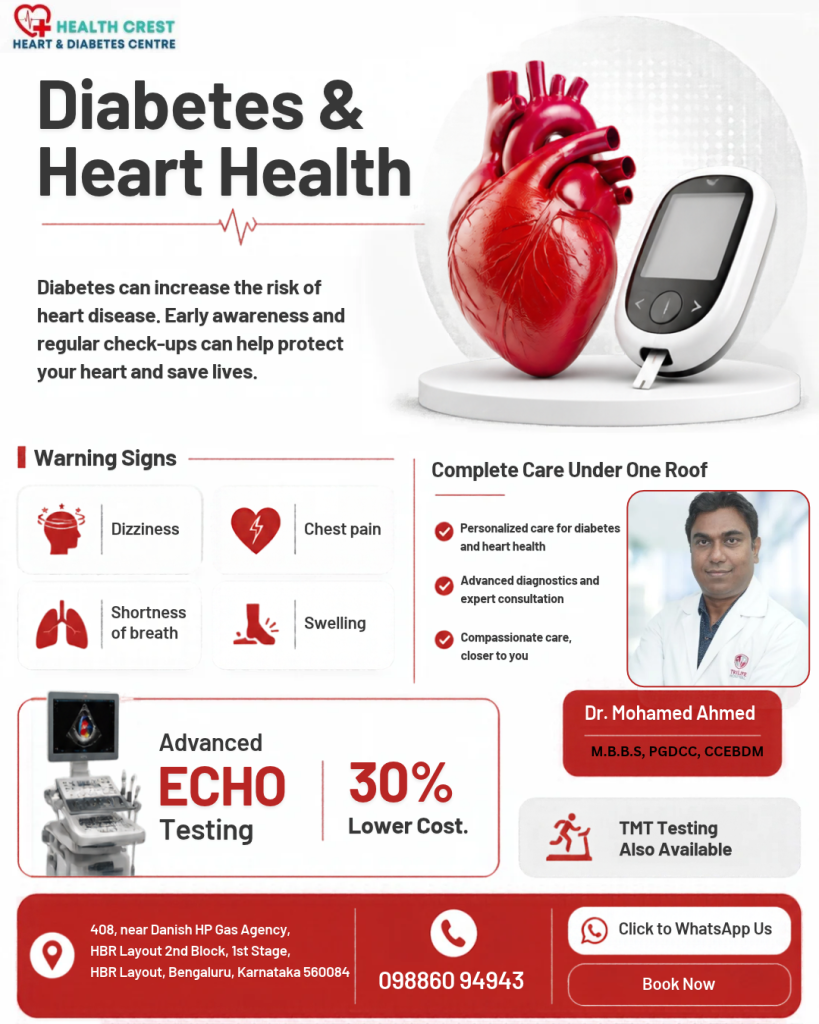
The Silent Connection: How High Blood Sugar Secretly Damages Your Heart
Author: Dr. Mohamed Ahmed (Cardiologist & Diabetologist | 22 Years Experience)
Are You Only Treating Half of the Problem?
If you or a loved one has been diagnosed with diabetes, you likely know the daily routine: checking your blood sugar, watching your diet, and taking your medication. It takes a lot of effort to keep those numbers in check. But there is a hidden danger that many patients are completely unaware of until it is too late.
Did you know that having diabetes automatically makes you twice as likely to develop heart disease?
In the medical world, diabetes and heart health are deeply connected. Treating one without keeping a close watch on the other is like locking the front door to your house but leaving the back door wide open. Let’s break down exactly why this happens, what signs to look out for, and how you can protect yourself.
How Does Sugar Damage the Heart?
To understand the connection, it helps to think of your blood vessels like a network of water pipes that carry oxygen to your heart.
When your blood sugar stays higher than normal for a long time, the extra sugar in your blood acts a bit like rust. It slowly starts to scratch and damage the smooth inner lining of your blood vessels.
Once these “pipes” are damaged, your body tries to heal them. But in the process, fat and cholesterol floating in your blood start sticking to the damaged areas. This buildup is called plaque. Over time, this plaque makes the blood vessels narrow and hard.
Because the vessels are narrow, your heart has to pump much harder to push the blood through. This leads to high blood pressure (hypertension). If one of these narrow vessels completely blocks, it causes a heart attack.
Diabetes Rarely Comes Alone Another reason diabetes is tough on the heart is that it usually brings “friends.” People with type 2 diabetes often also struggle with:
High Blood Pressure: Forces the heart muscle to overwork.
High Cholesterol: Adds to the plaque blocking the arteries.
Obesity: Puts extra physical strain on the heart to pump blood around a larger body mass.
When you combine high blood sugar, high blood pressure, and high cholesterol, it creates a perfect storm for heart disease.
5 Symptoms You Should Never Ignore:
One of the most dangerous things about diabetes is that nerve damage can actually mask chest pain. This means a diabetic person might have a heart issue without feeling the classic “crushing chest pain.” Keep a close eye out for these subtle warning signs:
Unexplained Shortness of Breath: Feeling winded after walking a short distance or climbing just a few stairs.
Dizziness or Lightheadedness: Feeling like you might faint when standing up quickly.
Extreme Fatigue: Feeling unusually exhausted, even if you slept well.
Swelling (Edema): Noticing that your shoes are suddenly too tight, or your ankles and feet look puffy.
A Tight or Squeezing Feeling: It might not be sharp pain, but rather a feeling of pressure in the chest, jaw, or left arm.
What to Expect During a Check-up:
If you have diabetes, global health guidelines recommend getting your heart checked regularly, even if you feel fine. Catching a blockage early can save your life.
When you visit our clinic, we use simple, painless tests to see exactly how your heart is performing:
ECG (Electrocardiogram): A quick 5-minute test that records the electrical signals in your heart. It helps us see if your heart rhythm is steady.
ECHO-Cardiography (ECHO): Think of this as an ultrasound for your heart. We use sound waves to take a live video of your heart pumping. It shows us if the heart muscle is strong and if the valves are working perfectly.
TMT-Stress Test: We monitor your heart while you walk on a treadmill. This helps us see how your heart handles physical stress and if there are any hidden blockages that only show up when you are active.
Complete, Affordable Care Under One Roof Visiting a Diabetologist in one hospital and a Cardiologist in another can be exhausting, confusing, and very expensive.
At Health Crest Heart & Diabetes Centre, we believe you deserve complete care in one place. Dr. Mohamed Ahmed brings 22 years of clinical experience specializing in both cardiology and diabetology. He doesn’t just look at your blood test; he looks at how your whole body is functioning.
We are also committed to honest, ethical healthcare. Middle-class families should not have to empty their savings for essential medical care. That is why we provide advanced diagnostics like ECHO (₹1,900) and TMT (₹2,000) at 30% lower costs than standard hospital rates. We operate with a strict no-commission policy—if you don’t need a test, we will never prescribe it.
Take the Next Step for Your Health
If you are managing diabetes, do not wait for the warning signs to appear. Protecting your heart is the most important step you can take for a long, healthy life with your family.
Schedule a comprehensive Diabetes & Cardiac Consultation today to get a clear, honest picture of your health.
📍 Visit Our Clinic: 408, near Danish HP Gas Agency, HBR Layout 2nd Block, 1st Stage, Bengaluru, Karnataka 560084
📞 Call to Book: 098860 94943